Environment & Energy
Related: About this forum
Quantifying Carbon Leakage from Renewable Shortfalls in China's Power System under Future Scenarios
Last edited Sat Jun 27, 2026, 11:00 PM - Edit history (1)
The paper I'll discuss in this post is this one: Quantifying Carbon Leakage from Renewable Shortfalls in China’s Power System under Future Scenarios Linze Hou, Jianxun Yang, Miaomiao Liu, Wen Fang, Zongwei Ma, and Jun Bi Environmental Science & Technology 2026 60 (20), 14456-14466.
This paper, for the record, involves some credulity inasmuch as it is involved with soothsaying. That said, it focuses on an important point, the point being that so called "renewable energy" is dependent on access to fossil fuels.
There are people around here, in many cases the same people who think that Germany is a so called "renewable energy" paradise, since there are zero fans of so called "renewable energy" who give a rat's ass about fossil fuels - their interest is in attacking the only sustainable form of primary energy there is, nuclear energy - who wish to represent China as some kind of "renewable energy" paradise as well.
It is no such thing.
We see lots of weakly disguised fossil fuel greenwashing ads here at DU and elsewhere, showing vast areas of wilderness rendered into industrial parks for so called "renewable energy" in China, coupled with claims that this unsustainable garbage is used to generate "green hydrogen."
This is, to put it bluntly, a bald faced lie. Electricity generation in China is some of the dirtiest on Earth and thus any electrolytic hydrogen generation in China is dirtier than coal, since the thermal generation of electricity destroys exergy.
In reality, China has over 1000 coal plants, more than the next 20 coal powered nations combined and well over 150 under construction and close to 250 under preconstruction planning. In China, the world's largest producer of hydrogen which it uses for the critical task of fertilizer synthesis using Haber-Bosch ammonia plants, hydrogen is overwhelmingly made by the steam reformation of coal.
According to the Electricity Map China has a 12 month carbon intensity of 483 grams CO2/kWh with coal combustion representing more than 55% of its electricity generation, even worse than that coal dependent hellhole Germany, with a 12 month carbon intensity of 342 grams CO2/kWh compared to nuclear powered France's 12 month carbon intensity of 32 grams CO2/kWh. In "percent talk" electricity's carbon intensity is China is 1,509% higher than that of France, and in Germany 1,069% higher than that of France.
China is also the world's largest producer of unsustainable land and material intensive so called "renewable energy," but since they are a highly industrialized nation, they understand the importance of reliability. Coal is a filthy fuel, but it is something that so called "renewable energy" is not, reliable. The only devices for the generation of electricity that is more reliable than coal are nuclear plants. China leads the world in nuclear power plant construction, and will surpass the United States as the world's largest producer of nuclear power shortly, with 61 nuclear plants operating and 39 under construction.
Nuclear energy is the only form of energy that is a clean, reliable, and sustainable alternative to coal. So called "renewable energy" is not reliable, nor is it, in my opinion, even remotely clean and sustainable, and thus it is not an alternative to coal, no matter how much bullshit is handed out claiming the opposite. So called "renewable energy" depends on access to dangerous fossil fuels.
China has announced that it has a capacity to build 50 nuclear power plants at a time, which is obviously not fast enough, but is better than every other nation on Earth. If their capacity for building nuclear plants continues to grow, to say well over 100 at a time, this is the only option that will address its growing dependence on coal. Obviously to stop building coal plants, China would need to have a capacity for simultaneous nuclear plant construction amounting to 50 + 150 = 200 at a time, if one can add and subtract, something with which I suspect antinukes and "I'm not an antinuke" antinukes apparently have a problem. Since China has displaced the collapsing United States - a nation falling to the power of extreme ignorance - as the world leader in science and engineering, it seems "possible" which is not the same world as "likely".
To shut all of its 1,207 coal plants within 10 years, while not building any more coal plants, China would need to have a capacity to build roughly 300 nuclear plants simultaneously. At that point however, with over 1500 nuclear power plants, electricity would be as clean as that of France, which pretty much has the cleanest electricity in the world. Fifteen hundred nuclear plants is more than 3 times larger than the current world inventory of operable nuclear plants, 438, with another 80 such plants under construction worldwide.
This would not be easy for China, or any nation, to do. In another context I recently quoted my favorite Democrat ever, Eleanor Roosevelt, somewhat out of context, since she was addressing a topic her husband famously also did, fear, and I'm spinning the statement to address a subtext of fear, which is hopelessness leading to a lack of effort. Quoth Eleanor:
To save the world, we must do the thing we think we cannot do, build thousands of nuclear plants rapidly. In this, China, a scientific, manufacturing, and engineering powerhouse, can serve humanity while saving itself. (China also leads the world in deaths from air pollution, quite possibly, although I'm guessing, on a per capita basis.)
A point:
The paper cited at the beginning of this post mentions the word "nuclear" zero times.
It assumes that China will rely on so called "renewable energy" and thus begins the text with a nonsense statement, which I will put in bold:
So called "renewable energy" which has soaked up close to 5.7 trillion dollars in the last ten years has had no effect whatsoever in reducing the use of dangerous fossil fuels, which are being consumed at the highest level ever observed. (Free Registration is required to access the data in the link just provided.)
"I'm not an antinuke" antinukes around here seem to like graphics to support their rhetorical nonsense, which often involves soothsaying (as this paper does), so here's a graphic, not based on soothsaying but rather on "data," from the IEA about world sources of energy:
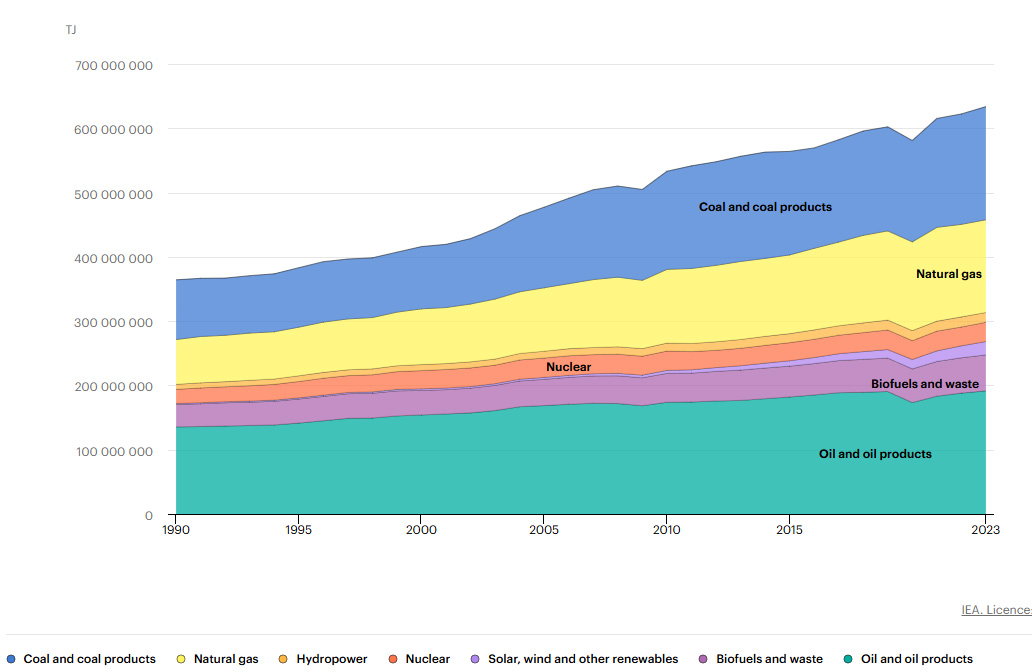
Total energy supply (TES) by source, World, 1990-2023 (Accessed 6/27/2026)
It should be obvious that despite the tremendous and frankly, wasteful, expenditure on solar and wind energy, they remain trivial, especially when compared to dangerous fossil fuels about which antinukes and "I'm not an antinuke" antinukes couldn't care less.
After the appalling and completely ridiculous opening sentence of the paper under discussion, it becomes more realistic.
The weather dependence of both supply and demand is a key driver of intrasystem carbon leakage. (7) These imbalances often translate into renewable shortfalls, which in most countries are still predominantly compensated by thermal power, thereby linking variability directly to additional fossil emissions. On the supply side, VRE generation is highly sensitive to meteorological conditions such as solar irradiance and wind speed, leading to significant fluctuations across daily time scales and spatial regions. For example, over the past two decades, the Middle East, North Africa, the Great Lakes region, the equatorial belt of Asia, and southwestern Australia have experienced declines in photovoltaic output. (8,27) It is projected that future climate change might reduce wind power potential across 30° S–30° N by approximately 5–10%. (9) On the demand side, electricity consumption displays strong seasonality and responds directly to temperature extremes, reflecting heating and cooling needs. (10) These joint dynamics of supply and demand can yield persistent mismatches. (11)
In this excerpt I have bolded a statement that is obvious, while including something of which I have been unaware, that from reference 9. Reference 9 is from the Nature Springer family of journals. This is it:
(Although I have not yet read reference 9 yet, having just downloaded it, from the title I infer the following: Even though wind industry is observationally demonstrated to be useless at addressing climate collapse, throwing more money at it will even be less effective to address the task than it has already established itself as being as the failure to address the climate collapse proceeds).
A note:
I read a lot of scientific papers by the way, a larger and larger number of them coming from Chinese authors in and out of China. Many of the papers have obviously been translated from Chinese into English, and one can see certain signatures of translation, often in the lack of use of English pluralization. By contrast with some of the papers with Chinese authors that I read, the English in this paper is excellent. I mention this since I would quibble to the word they chose define, "leakage." It's not "leakage." It's dependence. So called "renewable energy" depends on the use of and access to fossil fuels. Anyone who opposes all use of fossil fuels, as I do, cannot therefore support so called "renewable energy." Wind turbines and solar cells do not leak fossil fuels after they are manufactured and installed using fossil fuel energy, generally as sources of heat, but also including transportation, installation, etc.
Anyway...
A graphic from the paper outlining the framework of the investigation:
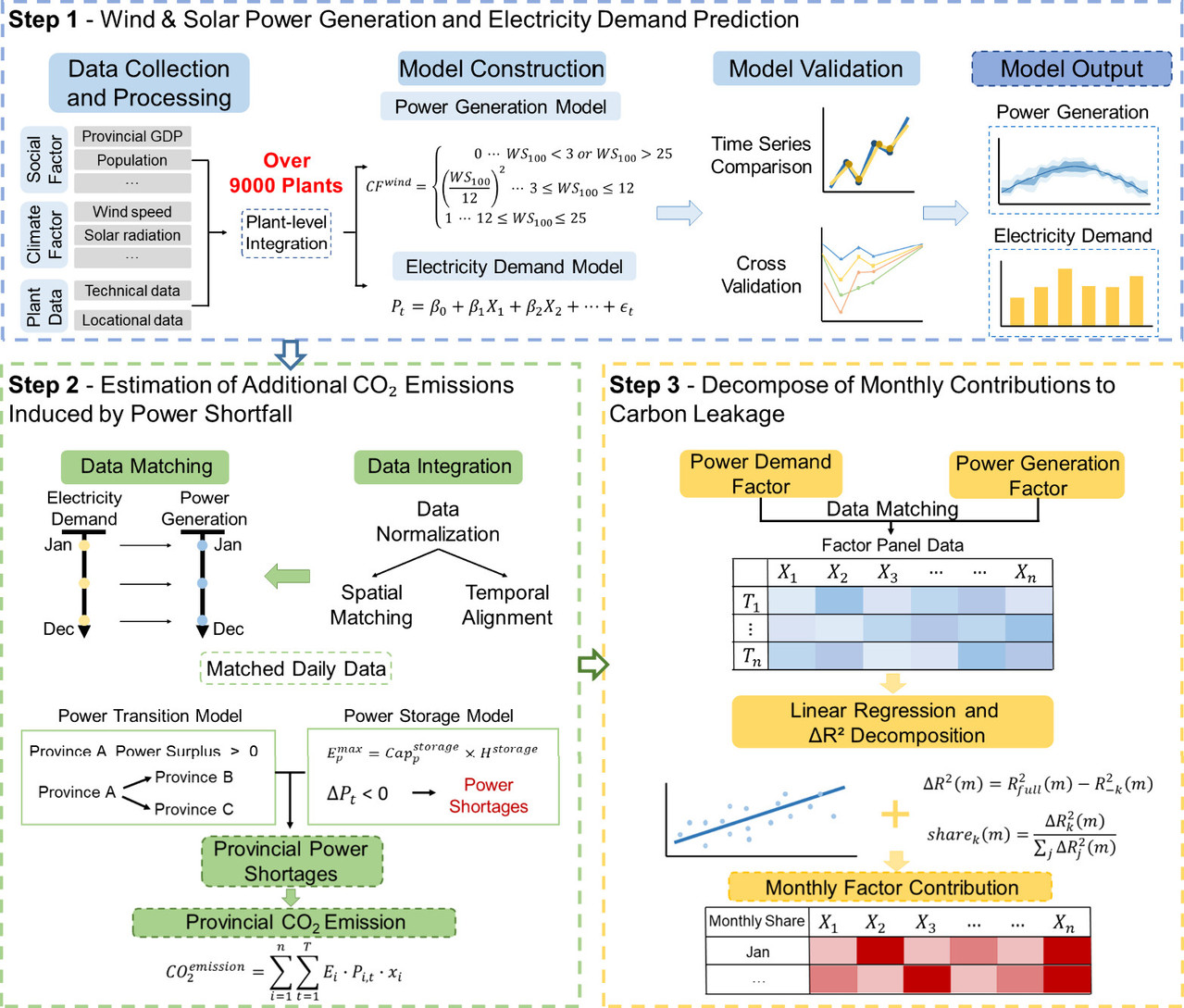
The caption:
Some related text:
We integrate three primary data categories, namely, renewable energy facility data, climate data, and socioeconomic data. We compiled data for over 9700 large-scale wind and solar photovoltaic installations across 30 Chinese provinces with wind and solar plants accounting for 61 and 39%, respectively. For each plant, we collected geographic coordinates, installed capacity, generation technology, operational status, and grid connection attributes from the China Renewable Energy Spatial Data set and Global Energy Monitor’s Global Solar and Wind Trackers. (20,20) These sources cover 95% of China’s total installed wind and solar capacity as of 2020.
An additional figure:
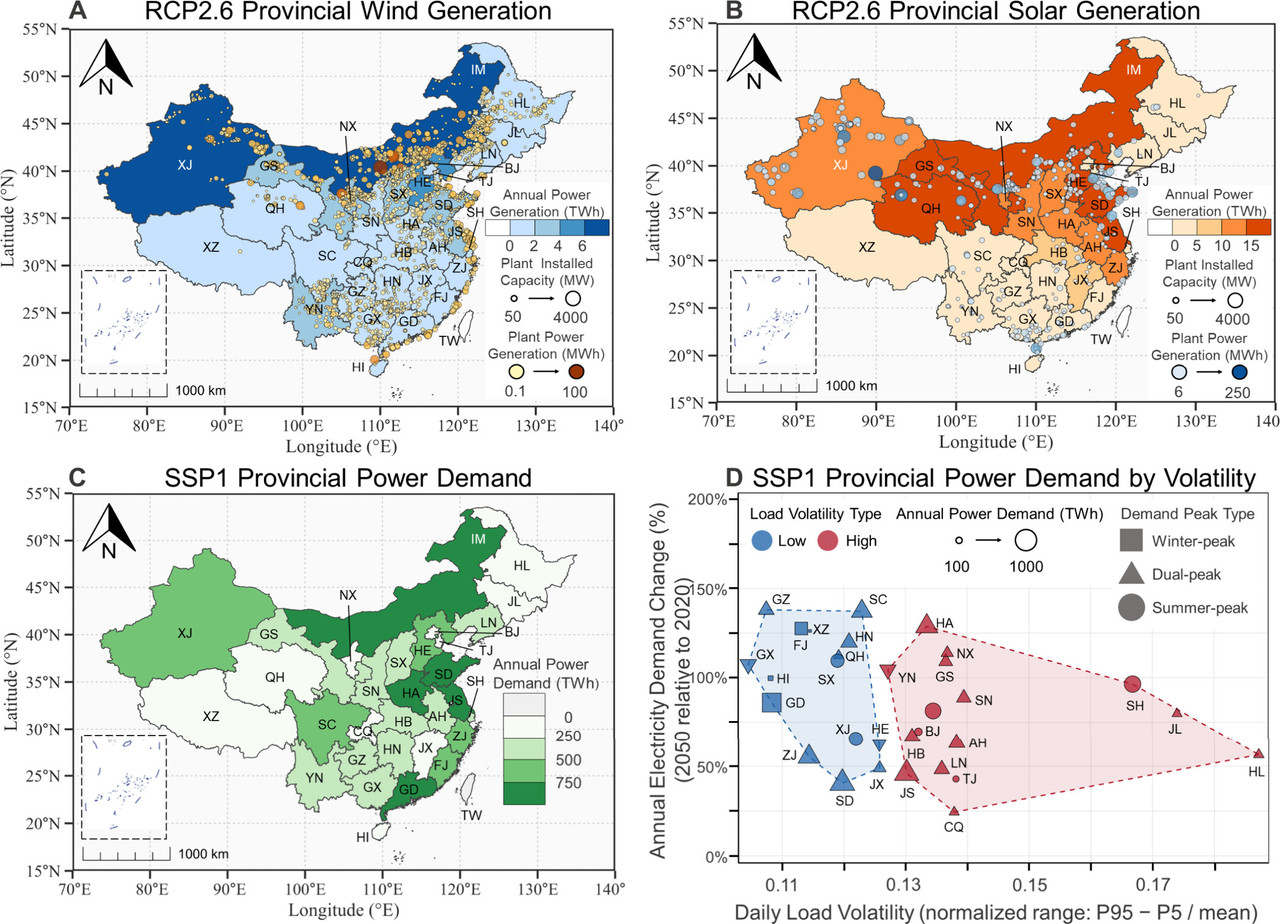
The caption:
The authors offer some equations, replete with empirical constants (too many in my view) for the capacity factors of wind and solar installations, which I have placed in graphic objects to avoid the limitations of the DU editor which lacks an equation function:
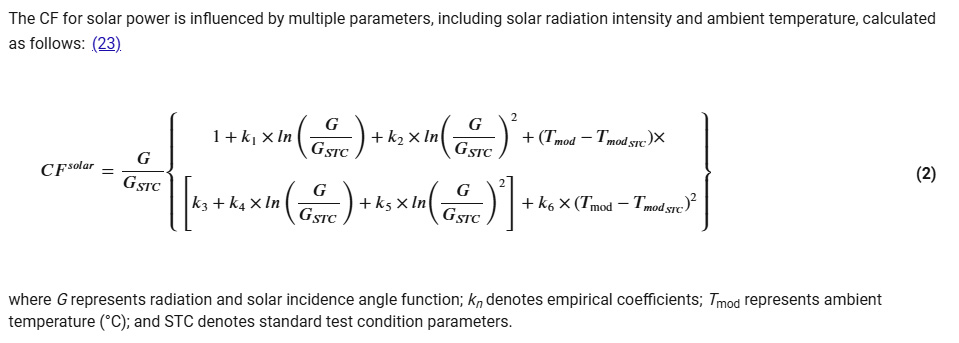
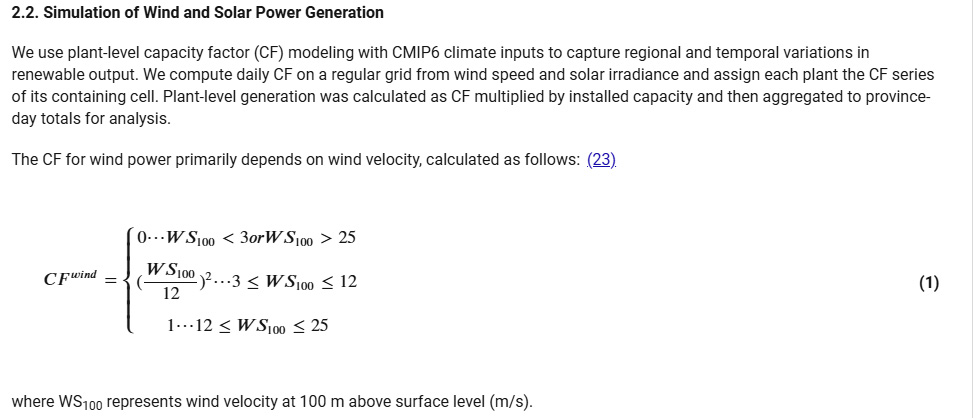
Addition text immediately after these equations:
An additional figure, outlining results claimed by the authors:
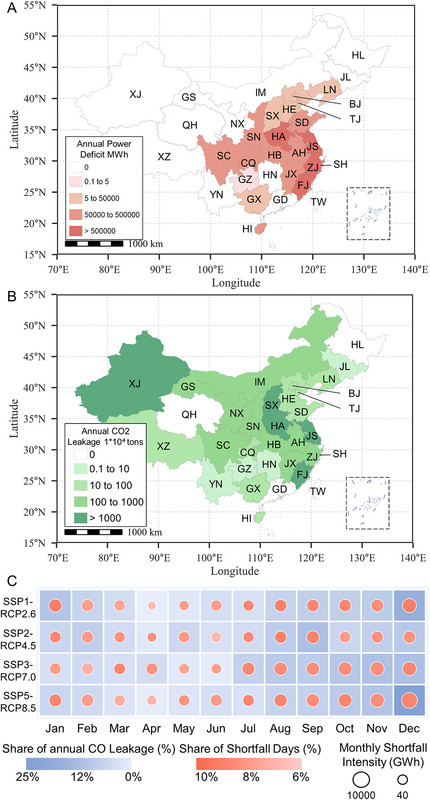
The caption:
Contributors to the need to combust fossil fuels dumping the waste into the planetary atmosphere to address shortages from the lack of reliability of so called "renewable energy."
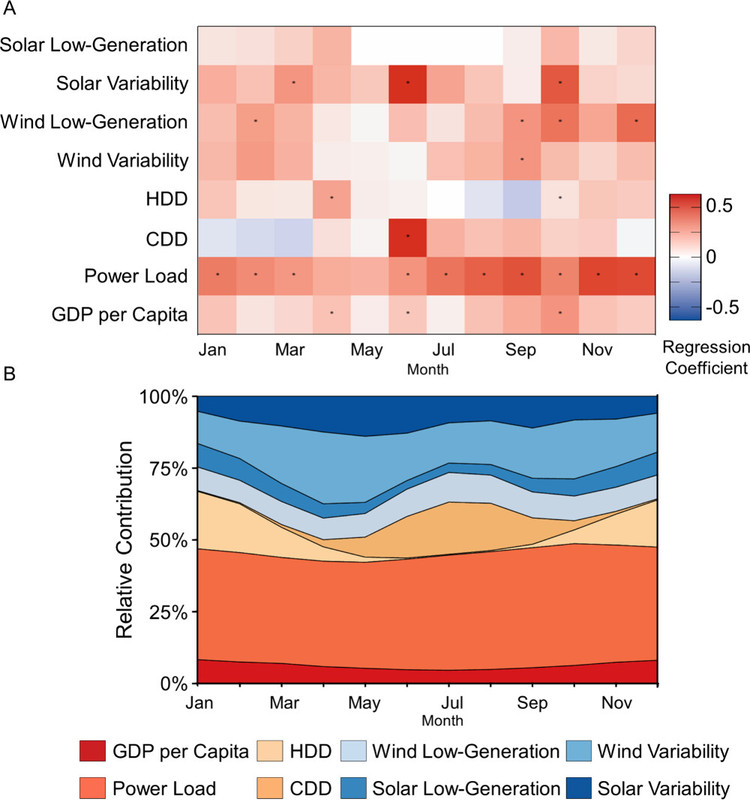
The caption:
HDD is "heating degree days" and CDD is "cooling degree days."
The authors some policy suggestions in the text, none of which speak to me as acceptable, since they ignore the obvious policy improvement of doing away with unreliable and unsustainable so called "renewable energy" in favor of sustainable, reliable, and clean nuclear energy.
Doing the policy improvement that I suggest, of course is not simple nor will it be easy. No nation has demonstrated the ability to be building hundreds of nuclear plants per year, although historically the United States and France, in far more primitive times, demonstrated the ability to have scores of plants under construction simultaneously. China has already exceeded nuclear power plant simultaneous plant construction records set in the 20th century by the United States and France. They must and should do better if they are to do away with coal.
As for reaching the scale of hundreds of plants under simultaneous construction all over the planet, I again appeal to Ms. Roosevelt:
I trust you're having a pleasant weekend.
 = new reply since forum marked as read
Highlight:
NoneDon't highlight anything
5 newestHighlight 5 most recent replies
= new reply since forum marked as read
Highlight:
NoneDon't highlight anything
5 newestHighlight 5 most recent replies

littlemissmartypants
(35,498 posts)
thought crime
(1,835 posts)In the actually existing world we really live in, renewable energy is rapidly developing to provide an obtainable transition to sustainable clean energy.
Nuclear plant buildout is slow and extremely expensive, and we don’t have the ability to safely manage the operation or the generated nuclear waste from thousands of additional nuclear plants. But we don’t need so many nuclear plants, because we are rapidly building many thousands of renewable plants along with improved electric grids to provide clean, reliable energy.
Also, you have it exactly backwards: Most fans of renewable energy do care very much about reducing use of fossil fuels, but don’t think much about nuclear energy at all because it can only provide a limited amount of energy in a safe and manageable way and doesn’t easily scale up like solar and wind energy. In fact, the nuclear industry would likely collapse if it wasn't heavily subsidized by governments that support it as an adjunct to nuclear weapons development.
Eleanor Roosevelt would understand all this. She would doubtless be an ardent supporter of renewable energy and would encourage nuclear bros to give up their dismal dystopian dreams.