Welcome to DU!
The truly grassroots left-of-center political community where regular people, not algorithms, drive the discussions and set the standards.
Join the community:
Create a free account
Support DU (and get rid of ads!):
Become a Star Member
Latest Breaking News
Editorials & Other Articles
General Discussion
The DU Lounge
All Forums
Issue Forums
Culture Forums
Alliance Forums
Region Forums
Support Forums
Help & Search
Environment & Energy
Related: About this forum
A Single Canadian Mine Has Been Leaking Hydrogen From Billion-Year-Old Rock for Over a Decade
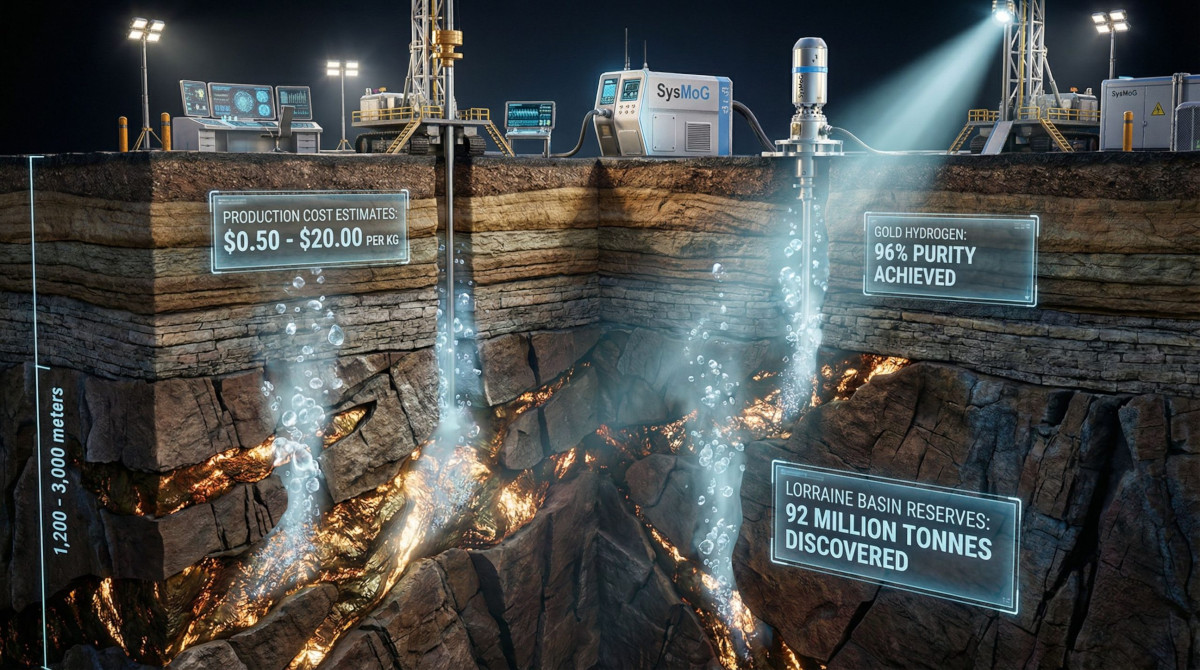
A Single Canadian Mine Has Been Leaking Hydrogen From Billion-Year-Old Rock for Over a Decade — About a Car Battery’s Worth From Each of Its 15,000 Boreholes. Nobody Had Ever Measured It Until Now
autonocion.com | Luis Reyes | May 31, 2026
Hydrogen cars were supposed to fix the things people still grumble about with EVs. Five-minute fill-ups, a few hundred miles of range, nothing out the tailpipe but water vapor. The part that never worked was the fuel itself. Clean hydrogen comes from either splitting water with a wall of electricity or stripping it out of natural gas and venting the carbon you were trying to avoid, and both are expensive enough that the Toyota Mirai spent a decade as a curiosity instead of a Camry. So the interesting thing about a new Canadian study isn’t really the chemistry. It’s that the planet appears to be making the fuel on its own, underground, and for the first time someone put a meter on it.
The paper landed in the Proceedings of the National Academy of Sciences on May 18, with the University of Toronto announcing the findings. Geochemists from U of T and the University of Ottawa measured natural hydrogen, what the industry has started calling “white” hydrogen, building up and discharging inside the Canadian Shield, the band of billion-year-old crust wrapped around Hudson Bay. They didn’t estimate it from a model. They went down into an operating mine near Timmins, Ontario, sampled the gas coming out of boreholes drilled into some of the oldest rock on Earth, and tracked it for as long as 11 years in places.
Eight kilograms a borehole, and a lot of boreholes
Each borehole gives off about 8 kilograms of hydrogen a year, which the researchers point out is roughly the weight of a car battery, and it keeps doing that for a decade or more. On its own that’s a rounding error. The site near Timmins has close to 15,000 of them. Run the math across all of them and you get more than 140 metric tons of hydrogen a year out of a single location — enough, the team estimates, to generate around 4.7 million kilowatt-hours and cover the yearly energy needs of more than 400 households.
The boreholes the team sampled sit deep, between roughly 6,800 and 7,850 feet down, and the hydrogen turning up in the gas ran from under 1% to nearly 13%. None of that is theoretical. The whole point of the study, which lead author Barbara Sherwood Lollar (a University Professor in U of T’s Department of Earth Sciences) and Ottawa’s Oliver Warr keep circling back to, is that this is measured output sustained over years, not a figure pulled off a whiteboard...more
https://www.autonocion.com/us/canadian-mine-hydrogen-rock/
SCIENTISTS DISCOVER MASSIVE NATURAL HYDROGEN SOURCE IN CANADA
CBC Nova Scotia News May 12, 2026 | White hydrogen
Memory Hole: A few years ago "Everyone" said "There's no such thing as white hydrogen" LOL. No one should ever say "There's no such thing as arrogant humans"
1 replies
 = new reply since forum marked as read
Highlight:
NoneDon't highlight anything
5 newestHighlight 5 most recent replies
= new reply since forum marked as read
Highlight:
NoneDon't highlight anything
5 newestHighlight 5 most recent replies
= new reply since forum marked as read
Highlight:
NoneDon't highlight anything
5 newestHighlight 5 most recent replies
A Single Canadian Mine Has Been Leaking Hydrogen From Billion-Year-Old Rock for Over a Decade (Original Post)
Caribbeans
18 hrs ago
OP

OKIsItJustMe
(22,236 posts)1. More here