Welcome to DU!
The truly grassroots left-of-center political community where regular people, not algorithms, drive the discussions and set the standards.
Join the community:
Create a free account
Support DU (and get rid of ads!):
Become a Star Member
Latest Breaking News
Editorials & Other Articles
General Discussion
The DU Lounge
All Forums
Issue Forums
Culture Forums
Alliance Forums
Region Forums
Support Forums
Help & Search
Environment & Energy
Related: About this forum
IEA - Global Energy Review 2026 - Technology: Solar PV and wind
(Please note: The following content is taken from a Creative Commons source.)
IEA (2026), Global Energy Review 2026, IEA, Paris https://www.iea.org/reports/global-energy-review-2026, Licence: CC BY 4.0
…
In 2025, global annual renewable capacity additions increased by 16%, reaching 800 GW despite challenges linked to supply chain strains, grid connection delays, financial pressures and policy shifts. This marked the 23rd consecutive year that renewables set new expansion records. Solar PV accounted for more than three quarters of new renewable capacity additions worldwide, followed by wind (20%). The remaining share was made up by hydropower, bioenergy, geothermal, concentrating solar power and marine energy.
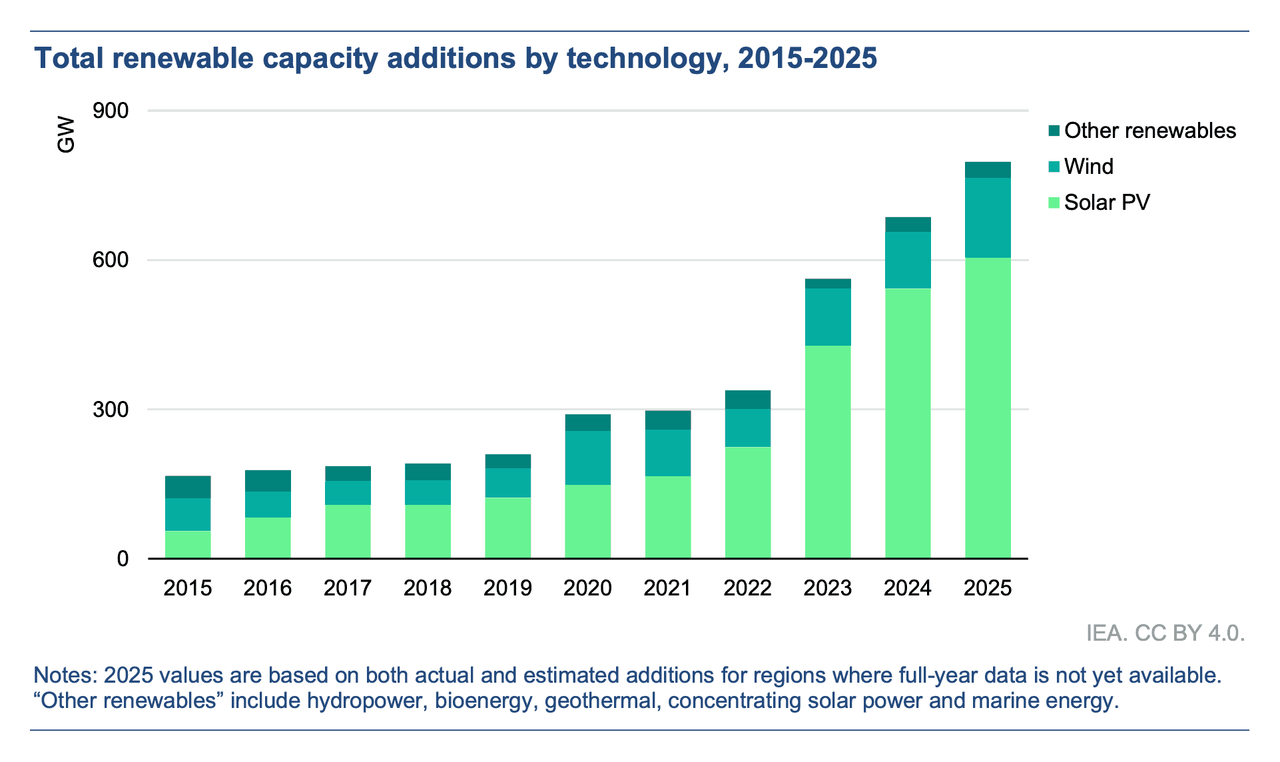
Solar PV capacity additions in 2025 rose by around 12%, surpassing 600 GW for the first time. This expansion brought cumulative solar PV capacity to around 2 800 TW, becoming the technology with the largest installed capacity globally. Thirty countries installed over 1 GW of solar PV in a single year, almost twice as many as in 2020. Meanwhile, following stable growth in 2024, annual wind capacity additions increased by nearly 40% globally, setting a new record at around 160 GW, despite ongoing supply chain challenges.
Solar PV and wind set new records in key markets, while China continued to drive global renewable deployment
Renewable capacity expansion in China continued to increase in 2025, reaching a new record with nearly 500 GW of additions, accounting for over 60% of global growth. Last year, China alone commissioned nearly 370 GW of solar PV and 117 GW of wind capacity – 13% and 48% higher, respectively, than in 2024. The country’s shift from long-term fixed tariffs to competitive auctions, effective June 2025, prompted developers to rush solar PV installations in the first half of the year, followed by a slowdown in the second half. In contrast, wind installations continued to accelerate in the latter half of 2025 as large-scale “mega-base” projects outside the auction scheme were completed.
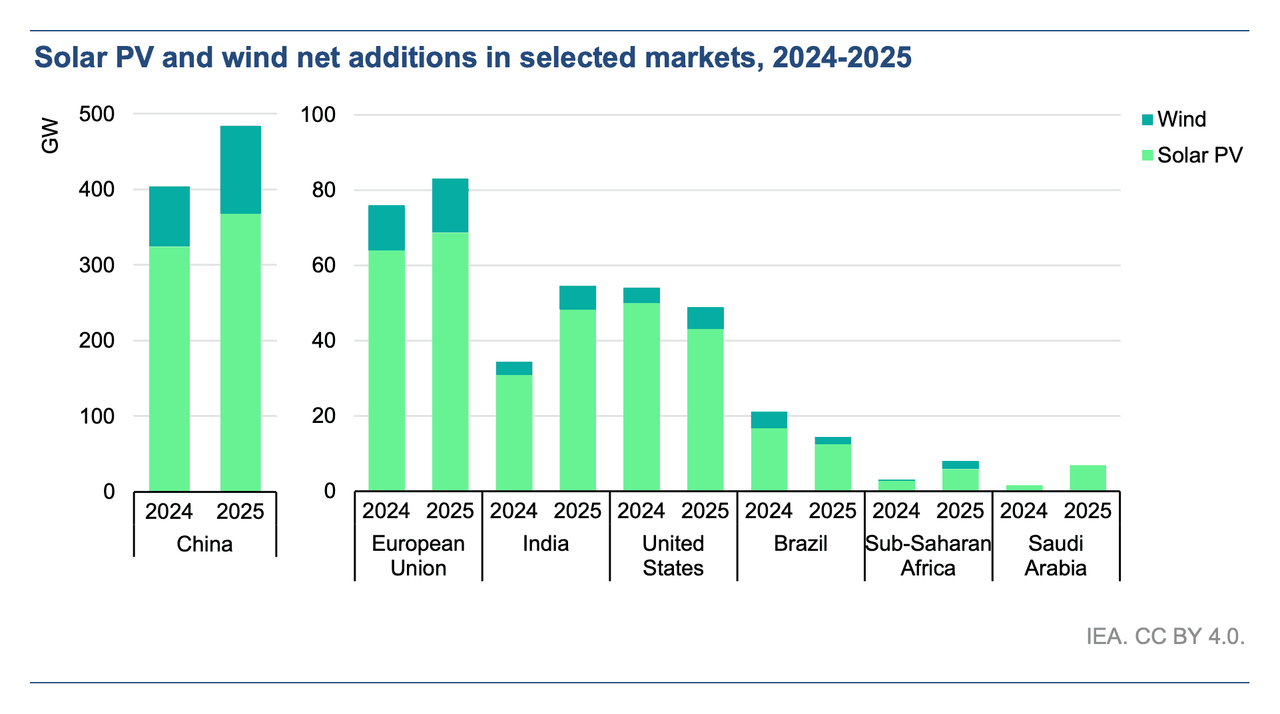
In 2025, the European Union added nearly 85 GW of new renewable capacity, a record high and about 10% more than in 2024. Solar PV led the way with almost 70 GW installed. Germany added 17 GW, accounting for one-quarter of total EU solar PV additions. Spain hit a record 14 GW of solar PV additions, up 50% from 2024 and accounting for one-fifth of the EU total. Several other countries, including France, Lithuania and Romania, also set new records. Onshore wind capacity additions rose to about 13 GW in the European Union. Offshore wind additions, however, fell to just 1 GW, down from 1.7 GW in 2024, with only France and Germany installing new capacity.
India’s annual renewable capacity additions increased by almost 60% in 2025, the fastest growth among major markets. This was driven by the commissioning of almost 50 GW of solar PV. India’s wind additions, while much smaller compared with solar PV, doubled in 2025 to reach over 6 GW. The United States installed 49 GW of renewable capacity in 2025, a decline of 10% compared with the previous year, led by lower solar PV additions.
Renewable capacity additions doubled both in sub-Saharan Africa and in the Middle East and North Africa, reaching around 12 GW in both regions. In sub-Saharan Africa, growth came from a combination of technologies, including solar PV, hydropower and wind – led by South Africa, which installed over 3 GW of solar PV for the first time. Saudi Arabia’s solar PV additions quadrupled to nearly 7 GW. Meanwhile, solar PV installations continued to grow in Pakistan as well, with around 10 GW of additions in 2025. This was driven almost entirely by on- and off-grid distributed systems.
…
In 2025, global annual renewable capacity additions increased by 16%, reaching 800 GW despite challenges linked to supply chain strains, grid connection delays, financial pressures and policy shifts. This marked the 23rd consecutive year that renewables set new expansion records. Solar PV accounted for more than three quarters of new renewable capacity additions worldwide, followed by wind (20%). The remaining share was made up by hydropower, bioenergy, geothermal, concentrating solar power and marine energy.
Solar PV capacity additions in 2025 rose by around 12%, surpassing 600 GW for the first time. This expansion brought cumulative solar PV capacity to around 2 800 TW, becoming the technology with the largest installed capacity globally. Thirty countries installed over 1 GW of solar PV in a single year, almost twice as many as in 2020. Meanwhile, following stable growth in 2024, annual wind capacity additions increased by nearly 40% globally, setting a new record at around 160 GW, despite ongoing supply chain challenges.
Solar PV and wind set new records in key markets, while China continued to drive global renewable deployment
Renewable capacity expansion in China continued to increase in 2025, reaching a new record with nearly 500 GW of additions, accounting for over 60% of global growth. Last year, China alone commissioned nearly 370 GW of solar PV and 117 GW of wind capacity – 13% and 48% higher, respectively, than in 2024. The country’s shift from long-term fixed tariffs to competitive auctions, effective June 2025, prompted developers to rush solar PV installations in the first half of the year, followed by a slowdown in the second half. In contrast, wind installations continued to accelerate in the latter half of 2025 as large-scale “mega-base” projects outside the auction scheme were completed.
In 2025, the European Union added nearly 85 GW of new renewable capacity, a record high and about 10% more than in 2024. Solar PV led the way with almost 70 GW installed. Germany added 17 GW, accounting for one-quarter of total EU solar PV additions. Spain hit a record 14 GW of solar PV additions, up 50% from 2024 and accounting for one-fifth of the EU total. Several other countries, including France, Lithuania and Romania, also set new records. Onshore wind capacity additions rose to about 13 GW in the European Union. Offshore wind additions, however, fell to just 1 GW, down from 1.7 GW in 2024, with only France and Germany installing new capacity.
India’s annual renewable capacity additions increased by almost 60% in 2025, the fastest growth among major markets. This was driven by the commissioning of almost 50 GW of solar PV. India’s wind additions, while much smaller compared with solar PV, doubled in 2025 to reach over 6 GW. The United States installed 49 GW of renewable capacity in 2025, a decline of 10% compared with the previous year, led by lower solar PV additions.
Renewable capacity additions doubled both in sub-Saharan Africa and in the Middle East and North Africa, reaching around 12 GW in both regions. In sub-Saharan Africa, growth came from a combination of technologies, including solar PV, hydropower and wind – led by South Africa, which installed over 3 GW of solar PV for the first time. Saudi Arabia’s solar PV additions quadrupled to nearly 7 GW. Meanwhile, solar PV installations continued to grow in Pakistan as well, with around 10 GW of additions in 2025. This was driven almost entirely by on- and off-grid distributed systems.
…
IEA (2026), Global Energy Review 2026, IEA, Paris https://www.iea.org/reports/global-energy-review-2026, Licence: CC BY 4.0