IEA: Rapid clean energy deployment displaces fossil fuels and lowers emissions
Last edited Wed Apr 22, 2026, 06:45 PM - Edit history (1)
The deployment of solar PV, wind power, nuclear power, electric cars and heat pumps since 2019 avoided annual global fossil fuel energy demand of more than 35 EJ in 2025. This is equivalent to around 7% of fossil fuel demand in 2025, or the combined total energy demand of Latin America. The deployment of these technologies displaced over 23 EJ of coal, more than 9 EJ of natural gas, and around 3 EJ of oil in 2025. The coal displaced exceeds India’s total coal demand in 2025, while natural gas displacement is equivalent to almost half the global LNG market. Electric cars account for roughly two-thirds of the annual oil displaced, with part of the emissions reductions impact of this displacement offset by increases in coal and natural gas use to meet additional electricity demand.
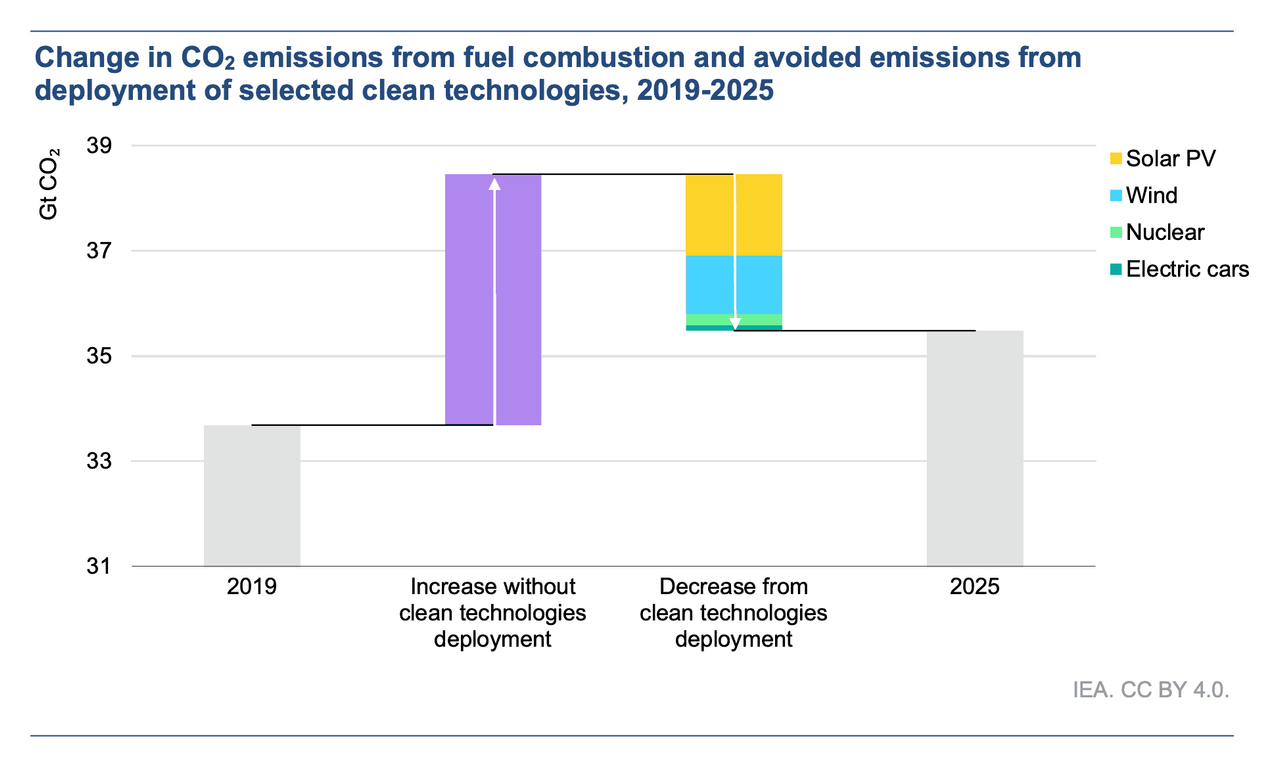
Together, solar PV, wind power, nuclear power, electric cars and heat pumps avoided around 3 Gt of CO₂ emissions in 2025, equivalent to around 8% of global energy-related CO₂ emissions annually. In some markets, the impact has been even more pronounced. In China, the European Union, Australia, New Zealand and Brazil, the deployment of these technologies since 2019 avoided the equivalent of more than 10% of energy-related CO₂ emissions in 2025.
Globally, the rollout of solar PV made the largest contribution, avoiding 1.5 Gt of annual CO₂ emissions, equivalent to around half of India’s total annual CO₂ emissions in 2025. Half of the emissions avoided by solar PV were in China.
Avoided emissions from deployment of wind power amounted to 1.1 Gt of CO₂, equivalent to the combined annual emissions of France, Germany and Italy. Nuclear power, electric cars and heat pumps followed at 210 Mt, 100 Mt and 90 Mt of CO₂ respectively. While the avoided emissions from electric cars and heat pumps are lower than from the other technologies studied, they may increase in coming years as the stock of these technologies continues to expand.
IEA (2026),
Global Energy Review 2026, IEA, Paris
https://www.iea.org/reports/global-energy-review-2026, Licence:
CC BY 4.0
