Welcome to DU!
The truly grassroots left-of-center political community where regular people, not algorithms, drive the discussions and set the standards.
Join the community:
Create a free account
Support DU (and get rid of ads!):
Become a Star Member
Latest Breaking News
Editorials & Other Articles
General Discussion
The DU Lounge
All Forums
Issue Forums
Culture Forums
Alliance Forums
Region Forums
Support Forums
Help & Search

No guide for the future - A review of Carl Benedikt Frey's 'How Progress Ends', Princeton University Press, 2025

https://feps-europe.eu/inspiration/how-progress-ends/

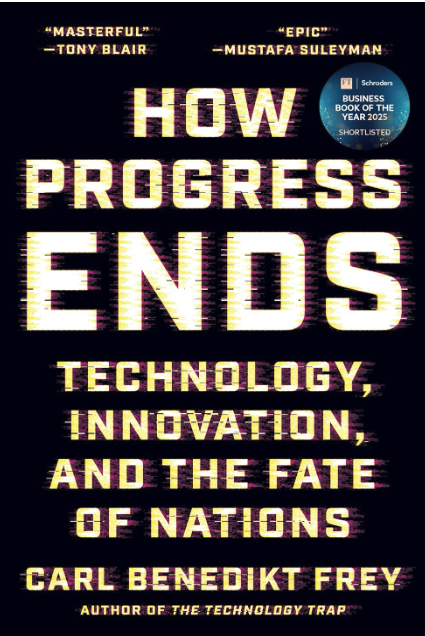

Carl Benedikt Frey’s How Progress Ends begins with the dramatic language of crisis, bowing to the attention economy, but offers a measured reflection on the sources and limits of modern innovation. Building on his earlier work, Frey attributes contemporary stagnation to alleged growing caution, institutional rigidity, and the fading spirit of discovery that, in his opinion, once drove economic growth. Yet the history of progress he invokes is far from innocent: much of it came from simple greed and depended on exploitation, from enslaved labour to the industrial working class. Frey’s economic history is rich and well-argued, and his challenge to the myth of unstoppable progress is a welcome one. He rightly reminds readers that prosperity depends on governance, law, and institutional design – factors that are often overlooked in today’s technology narratives. However, his diagnosis overlooks the deep structural flaws of the modern economy: the failures of markets to serve public needs, the distortions and abuse of corporate power, widening inequality, and ecological breakdown.
At the centre of Frey’s thesis lies a tension between two forces. One is the decentralised creativity of individuals and small networks – visible in Enlightenment cafés or Silicon Valley garages. The other is the bureaucratic capacity of large corporations to standardise and scale ideas, reaping economies of scale and enabling worldwide distribution. Progress, he argues, occurs when societies manage to match these models to the needs of the time. When institutions lose flexibility and fail to adapt the framework to the signs of the time – whether by favouring experimentation or size – stagnation follows. It is a clear and elegant framework, but one that ultimately separates the politics of who benefits from ‘progress’ and who bears its costs. The question is also of how to foresee the tipping point of change from one regime to the other. Where are we today, according to Frey? The answer is unclear.
That omission shapes much of Frey’s argument. His scepticism towards regulation and democratic constraint echoes the libertarian optimism of technology’s most vocal champions. He frames environmental and legal safeguards and the precautionary principle as obstacles to innovation, aligning – perhaps unintentionally – with right-wing billionaires like Peter Thiel, who equate freedom with deregulation, low taxes and the right to be contrarian and reckless. In doing this, Frey mistakes symptoms for causes. The problem is not that societies have grown risk-averse; it is that private interests have captured innovation. What he calls timidity is often the public’s rational response to an economy where the rewards of innovation in technologies or business models are privatised and its harms socialised.
This misreading becomes most visible in Frey’s silence on the rise of digital capitalism. The 21st-century economy is not a neutral arena for discovery, but a system shaped by financialisation, shareholder-value ideology and data extraction. These mechanisms have redirected creativity towards surveillance, speculation, and the manipulation of people and societies rather than towards productive or social ends. The so-called ‘productivity paradox’ – where immense technological investment produces meagre social and macroeconomic returns – reflects a deeper dysfunction: innovation has been decoupled from the common good and digital technology has been hyped. The same pattern is now visible in artificial intelligence. Despite enormous investment, most corporate AI projects yield little practical benefit. The issue is not bureaucratic inertia but the market incentives that reward short-term hype and a quick run to monopolistic control. When the brightest engineers are designing advertising AI for social networks instead of addressing planetary challenges, the obstacle to progress lies not in regulation but in capitalism’s priorities and incentives.
snip