General Discussion
Related: Editorials & Other Articles, Issue Forums, Alliance Forums, Region Forums = new reply since forum marked as read
Highlight:
NoneDon't highlight anything
5 newestHighlight 5 most recent replies
= new reply since forum marked as read
Highlight:
NoneDon't highlight anything
5 newestHighlight 5 most recent replies

SheltieLover
(76,860 posts)Not one word about any of this in the news.


Melon
(1,093 posts)This was in 2020. Federal drug charges were filed in NY Courts against Maduro, his wife, and others.
https://www.justice.gov/archives/opa/pr/nicol-s-maduro-moros-and-14-current-and-former-venezuelan-officials-charged-narco-terrorism

MichMan
(16,637 posts)Melon
(1,093 posts)
Ocelot II
(129,109 posts)Melon
(1,093 posts)
Ocelot II
(129,109 posts)Manuel Noriega was arrested in Panama and taken to the US for trial, and in that case the court did not address the question of whether the invasion that led to his capture was lawful, apparently considering that issue as irrelevant to the criminal case before it, and possibly beyond the scope of the court's authority to decide. Since Noriega was in custody following a valid indictment, the court didn't consider the legality of how he ended up there in the first place. That analysis, or the lack of it, may be constitutionally shaky but it's likely that the prosecution of Maduro will follow the same path.
hardluck
(761 posts) . Even if the extraterritorial conduct produces no effect within the United States, a defendant may still be reached if he was part of a conspiracy in which some co-conspirator's activities took place within United States territory. United States v. Baker, 609 F.2d 134, 138 (5th Cir. 1980). The former Fifth Circuit, whose decisions establish precedent for this Court, has on numerous occasions upheld jurisdiction over foreigners who conspired to import narcotics into the United States but never entered this country nor personally performed any acts within its territorial limits, as long as there was proof of an overt act committed within the United States by a co-conspirator. See United States v. Postal, 589 F.2d 862 (5th Cir.), cert. denied, 444 U.S. 832, 100 S. Ct. 61, 62 L. Ed. 2d 40 (1979); United States v. Cadena, 585 F.2d 1252 (5th Cir.1978); United States v. Winter, 509 F.2d 975 (5th Cir.), cert. denied, 423 U.S. 825, 96 S. Ct. 39, 46 L. Ed. 2d 41 (1975); Rivard v. United States, supra.
More recently, international law principles have expanded to permit jurisdiction upon a mere showing of intent to produce effects in this country, without requiring proof of an overt act or effect within the United States. See United States v. Wright-Barker, 784 F.2d 161, 168 (3rd Cir. 1986); United States v. Postal, 589 F.2d at 886, n. 39; United States v. Columba-Colella, 604 F.2d at 358, 360. According to the Restatement (Third):
Cases involving intended but unrealized effect are rare, but international law does not preclude jurisdiction in such instances, subject to the principle of reasonableness. When the intent to commit the proscribed act is clear and demonstrated by some activity, and the effect to be produced by the activity is substantial and foreseeable, the fact that a plan or conspiracy was thwarted does not deprive the target state of jurisdiction to make its law applicable.
ง 402, Comment d.
In the drug smuggling context, the `intent doctrine' has resulted in jurisdiction over persons who attempted to import narcotics into the United States but never actually succeeded in entering the United States or delivering drugs within its borders. The fact that no act was committed and no repercussions were felt within the United States did not preclude jurisdiction over conduct that was clearly directed at the United States. United States v. Wright-Barker, supra ("The purpose of these [narcotics laws] is to halt smugglers before they introduce their dangerous wares into and distribute them in this country."
(emphasis in original); United States v. Quemener, 789 F.2d 145, 156 (2d Cir.), cert. denied, 479 U.S. 829, 107 S. Ct. 110, 93 L. Ed. 2d 58 (1986); United States v. Loalza-Vasquez, 735 F.2d 153, 156 (5th Cir.1984); United States v. Baker, 609 F.2d at 138-39.https://law.justia.com/cases/federal/district-courts/FSupp/746/1506/1757098/
Melon
(1,093 posts)
milestogo
(22,590 posts)
Bettie
(19,287 posts)So, the law is whatever orange Hitler says it is.
That seems to be where we are now
LetMyPeopleVote
(175,007 posts)Here is Professor Vladeck's analysis of this "arrest". Under this legal theory, this was NOT a military operation but an arrest by two FBI agents who had to be protected by the military. That is the legal theory for not notifying congress. I agree with Professor Vladeck that this legal theory if pure BS and should not hold up.
"If we hadn’t already, we’ve unquestionably joined the league of ordinary nations—a league in which we’re acting as little more than a bully, and in circumstances in which no obvious principle of self-defense, human rights, or even humantarianism writ large justifies our bellicosity."
— Steve Vladeck (@stevevladeck.bsky.social) 2026-01-03T21:32:42.911Z
Me on Maduro:
https://www.stevevladeck.com/p/200-five-questions-about-the-maduro
The basis for that argument is the merger of two strands of legal arguments that have long been made by the Department of Justice—but never blessed by the Supreme Court. The first strand traces to a deeply controversial 1989 DOJ Office of Legal Counsel memorandum by then-Assistant Attorney General Bill Barr (yes, the same one), which concluded that the President has inherent constitutional authority to use the FBI for extraterritorial arrests, even in circumstances in which the arrests violate international law (e.g., by infringing upon a foreign nation’s sovereignty). The memo also concluded, quite … usefully, that such arrests don’t violate the Fourth Amendment. The second strand is DOJ’s longstanding view that the President has inherent constitutional authority to use military force to protect federal institutions and officers in the exercise of their federal duties. Thus, in a textbook example of the tail wagging the dog, the military force was merely the means by which President Trump “protected” the handful of FBI personnel who apparently were involved in the actual arrests.
Question #2: Okay, So Why Are Those Arguments Unpersuasive?
Without attempting to be exhaustive, it seems to me that there are at least three things to say about these arguments:
First, note how any reliance upon the Barr Memo is giving up the ghost on the (obvious) violations of Venezuela’s sovereignty—and, thus, the U.N. Charter (to say nothing of myriad other international agreements and precepts of customary international law). There’s no attempt to even try to argue that this operation was consistent with international law—for the obvious reason that … it isn’t. (There had been some suggestion earlier in the day that the Trump administration might try to identify Venezuelan officials who had “invited” the United States to breach Venezuela’s sovereignty, but that … hasn’t gone anywhere.) Thus, unlike the boat strikes, which have all occurred in the legally grayer area of international waters, Friday night’s operation involves a textbook violation of foreign sovereignty for which the Trump administration’s principal response appears to be “whatever.”
Second, it is the epitome of bootstrapping to use the idea of “unit self-defense” as the basis for sending troops into a foreign country so that a handful of civilian law enforcement officers can exercise authority they wouldn’t be able to exercise but for the military support. My friend and former State Department lawyer (and Cardozo law professor) Bec Ingber has written in detail about why the “unit self-defense” argument is effectively a slippery slope toward all-out war, and she’s right. It seems just as important to point out that the U.S. constitutional law argument seems just as limitless. If Article II authorizes the use of military force whenever a foreign national living outside the United States has been indicted in a U.S. court, that could become a pretext for the United States to use military force almost anywhere—in circumstances that could easily (and quickly) escalate to full-fledged hostilities. Something tells me the Founders, who were deeply wary of military power, would not exactly see this as consistent with what they wrote—at least until and unless Congress had done something to authorize, or even acquiesce in, these kinds of distinctly offensive military operations.
Third, and perhaps most importantly, the closest relevant historical precedent for this episode—the U.S. invasion of Panama in December 1989 (Operation “Just Cause”), which resulted in the deposing and arrest of Manuel Noriega—is distinguishable in one critical respect: In the Panama example, the Panamaian general assembly had formally declared a state of war against the United States, and a U.S. Marine had been shot and killed, before President George H.W. Bush authorized the underlying operation. And even then, there’s still nothing approaching consensus that Operation Just Cause was actually consistent with U.S. law; Congress passed no statute authorizing hostilities, and it was hard to see how the situation in Panama posed any kind of imminent threat to U.S. territory sufficient to trigger the President’s Article II powers—just like the Trump administration’s narco-trafficking claims seem difficult to reconcile with where fentanyl actually comes from (Mexico) or the Trump administration’s own behavior (like pardoning former Honduran president-turned-cocaine-trafficker Juan Orlando Hernández). In other words, the only real precedent for what happened Friday night doesn’t provide any legal support for the United States’ actions.
RoseTrellis
(108 posts)The Biden-Harris administration quite notably raised the original bounty for his arrest that the 1st Trump administration started to 25 million almost exactly a year ago.
I’m quite certain they were not concerned about the legality of his arrest warrant.
2 things can be true
#1 Maduro was a bad dictator that stole the election to remain in power and needed to be brought to justice
#2 Trump’s imperialist military action was primarily guided by thirst for Venezuelan oil
It’s important to consider most of the elected Democratic Leadership all agreed Maduro needed to go.
https://www.nytimes.com/2025/01/10/world/americas/biden-bounty-nicolas-maduro.html
LetMyPeopleVote
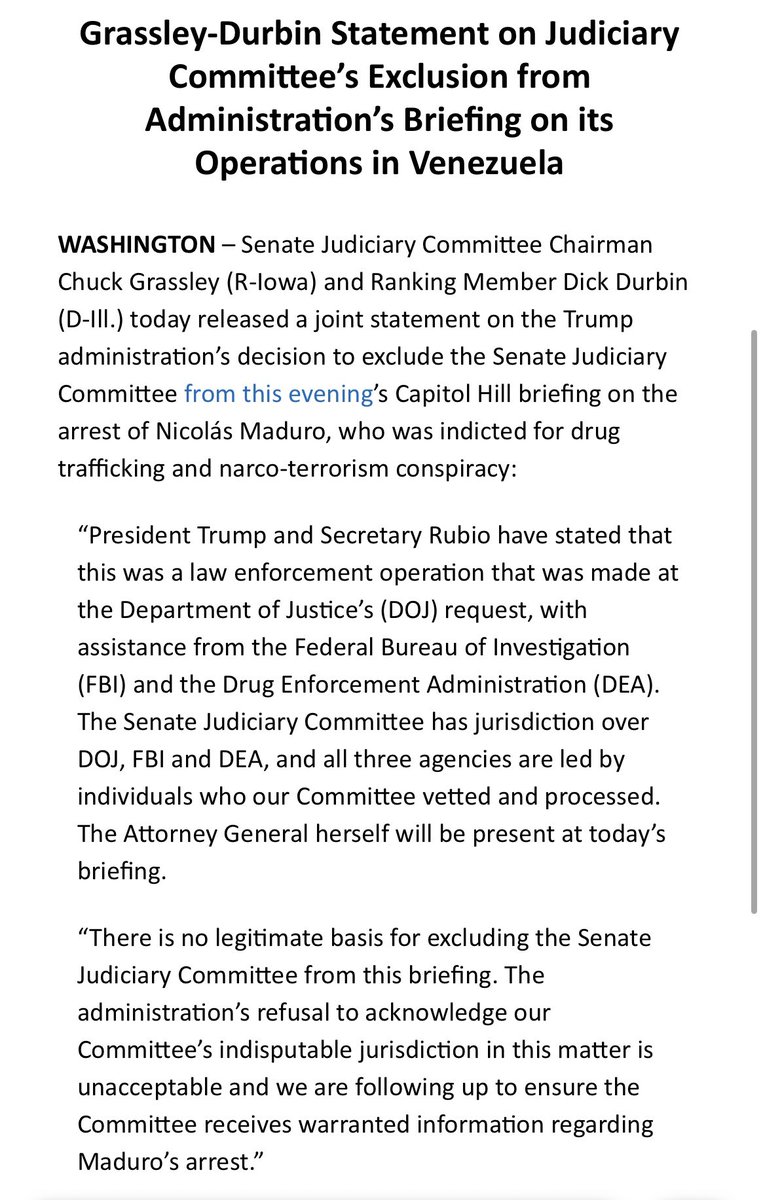
(175,007 posts)You cannot claim that this was a law enforcement action and then refuse to brief the Senate Judiciary Committee
Link to tweet